5.9.13
Gilles Deleuze + Fèlix Guattari : Anti-Oedipus: Capitalism and Schizophrenia (Bloomsbury Revelations, Paperback) - 25 - 04 - 2013
The collaboration of the philosopher Gilles Deleuze and the psychoanalyst Felix Guattari has been one of the most profoundly influential partnerships in contemporary thought.Anti-Oedipus is the first part of their masterpiece, Capitalism and Schizophrenia. Ranging widely across the radical tradition of 20th Century thought and culture that preceeded them - from Foucault, Lacan and Jung to Samuel Beckett and Henry Miller - this revolutionary analysis of the intertwining of desire, reality and capitalist society is an essential read for anyone interested in postwar continental thought.
Read more
4.9.13
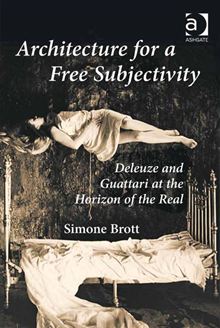
Architecture for a Free Subjectivity. Deleuze and Guattari at the Horizon of the Real - Simone Brott @ Ashgate, e.book, June 2013
Architecture for a Free Subjectivity
Deleuze and Guattari at the Horizon
of the Real
- Simone Brott, Queensland University of Technology, Australia
- Architecture for a Free Subjectivity reformulates the French
philosopher Gilles Deleuze's model of subjectivity for architecture,
by surveying the prolific effects of architectural encounter,
and the spaces that figure in them. For Deleuze and his Lacanian
collaborator Félix Guattari, subjectivity does not refer
to a person, but to the potential for and event of matter becoming
subject, and the myriad ways for this to take place.
By extension, this book theorizes architecture as a self-actuating
or creative agency for the liberation of purely "impersonal effects."
Imagine a chemical reaction, a riot in the banlieues, indeed a walk
through a city. Simone Brott declares that the architectural object
does not merely take part in the
production of subjectivity, but that it constitutes its own.
This book is to date the only attempt to develop Deleuze's
philosophy of subjectivity in singularly architectural terms.
Through a screening of modern and postmodern, American and European
works, this provocative volume draws the reader into a close
encounter with architectural interiors, film scenes,
and other arrangements, while interrogating the discourses of
subjectivity surrounding them, and the
evacuation of the subject in the contemporary discussion.
The impersonal effects of architecture radically
changes the methodology, just as it reimagines architectural
subjectivity for the twenty-first century.
Introduction
This book imagines and articulates an architectural subjectivity
privileged as impersonal effects, to be explored in the philosophy
of Gilles Deleuze and Félix Guattari, by retracing steps taken
earlier, in the 1970s and 1980s, by cultural and architectural
protagonists in the united States and japan. the following
discussions pursue a more abstract and, therefore, timely
investigation of the form and function of
impersonal effects in the architectural encounter.
Subjectivity is, for Deleuze, not a person, but a power given to
immanent forces to act and to produce effects in the world.
In short, it is the field of what i call subjectivization, meaning
the potential for and event of matter becoming subject, and the
multiple ways for this to take place.
Deleuze, in fact, tends not to use the word subjectivity, speaking
instead of “affects”—the capacity to affect and be affected—and
“pre-personal singularities,” meaning those irreducible qualities
or powers that act independently of any particular person.
To walk, to see, to love—these are general or anonymous capacities
that function in a very real sense prior to the personological
subject.
Singular, here, does not mean specific or rare, but the reverse:
the functions to sleep or to laugh are singular because sleeping
and laughing always retain a certain abstract quality or
impersonality, no matter who sleeps or laughs.
For Deleuze, the world is composed of so many singularities,
which together resonate silently toward a mystery of something
always already yet to come. the subject is understood, therefore,
not as identity but as a convergence of singularities immanent to
an encounter.
Deleuze is critical of both phenomenology
and psychoanalysis, as still engaging a classical (Cartesian)
notion of subject as individual or free agent, a form of subjectivity
premised on the separation of the subject and the object of that
subject’s attention.
In Deleuze’s worldview, the ordinary identity, the “i” of the
representational ego, is a ‘surface effect’ of impersonal processes
of differentiation and the repetition of pre-personal singularities.
What i call the impersonal effects are the inchoate,
not-yet-determined fragments of architectural encounter,
as opposed to the personal effects of identity, individuality or
the constituted collective.
Effect is not, in Deleuze’s sense, ephemeral—an effect of something
more primary; but rather, like a “magnetic effect,”
it is a productive force, an effect that works and creates.
By extension, the project here is to find and express, by
architectural means, the image of effects.
(Image, here, does not mean a photograph or
a media image; but, rather, a live “arrangement”
of effects at large in the world, like the realist cinema and
its image advocated by André Bazin.)
What qualifies such a pure (unmediated and unmediatic) image is
simply the mode in which it causes multiple effects to proliferate.
Unlike personal effects (a watch, a ring, a condominium) that clingPersonal effects in architecture generally produce a formalist
to the personal body, the impersonal effects of architecture—such as
those of a street, a store, or the bathroom at a party—belong to
everyone and to no one; they envelop the body from a distance, even
when they are up close. however, the impersonal effects can always
become repersonalized in their derivative mode where architecture
becomes objectified, the object of a proprietary relationship
(such as ‘my house’) where subject/object relations are restored.
typology of effects, invoking a suite of terms such as plan and
gestalt—in other words, the entire discursive apparatus of ‘design.’
But this is not to criticize such formalistic measures per se.
Only the most rigid and stultifying formalisms (for example,
those that prescribe architecture in advance and re-inscribe the
proprietary status of building, author, resident) must be avoided
when discussing or isolating impersonal effects. Architecture is not merely
what is made or planned, what is drawn or built. It also creates,
alters, and conditions interlocking subjectivized fields.
Read more [PDF]
31.8.13
L'immagine del pensiero: Filosofia e Performance - XX Edizione del Festival Crisalide @ Forlì, 5-10 settembre 2013
La ventesima edizione del Festival Crisalide (Forlì, dal 5 al 10 settembre), ideato e organizzato da Masque Teatro, è un intreccio distillato di filosofia e performance. L’immagine (dogmatica) del pensiero, uno dei principali bersagli critici del pensiero di Gilles Deleuze, viene assunta come linea guida di riflessione da Masque per riflettere sulla tessitura di regole precostituite che indirizzano, limitandolo, l’atto del pensare. L’immagine del pensiero sarebbe un sistema di coordinate e di orientamenti che “anticipano” l’atto filosofico e designano il presupposto implicito che il pensiero si dà di se stesso come “naturale” e “universale”: naturalmente indirizzato al vero nonché universalmente giusto. In altre parole, è solo un'illusione credere di pensare “liberi”, svincolati da sovrastrutture, metodi, modalità all’interno delle quali viaggia il pensiero. Lo sforzo di Deleuze si esplica allora nella volontà di inventare, a forza di sperimentazioni, un pensiero libero e strettamente legato alla realtà dei fatti – non “universale” o “Vero”, ma vitale e concreto. Un ritorno agli scritti del grande filosofo novecentesco, dopo l’affondo dedicato ai concetti di minorità e normalizzazione e a Felix Guattari con il progetto triennale Winter Years (2010>2012).
A partire da queste riflessioni Crisalide si propone di esplorare diverse modalità di esercizio creativo, sul piano della composizione artistica così come sul piano filosofico, privilegiando quegli interventi che si propongano come reale produzione di pensiero, che possano creare quelle condizioni di incontro, di «imbattersi fortuito», necessarie alla produzione di “una nuova capacità di pensare”.
Vent’anni fa nasceva il Festival non come vetrina ma come luogo dove potessero nascere e svilupparsi scambi di pensiero e confronto tra artisti e pensatori. L’Ex Filanda Maiani è diventata nel tempo il punto di riferimento per una messa in discussione non solo del fare teatrale e performativo ma anche per una messa in campo di alcune questioni teoriche che si muovevano dentro e fuori dalla scena. Obiettivo chiaro da sempre è stato per il Festival trovare vie di pensiero che potessero scardinare i dogmi, anche teatrali, e mettere in luce la forza propulsiva che risiede nel ricchissimo mondo delle marginalità produttive.
Crisalide XX | il programma nel dettaglio:
Il Festival inaugura giovedì 5 settembre con il laboratorio filosofico Critica della Ragion Creativa, ideato e coordinato da Paolo Vignola con i filosofi Vincenzo Cuomo, Eleonora de Conciliis, Riccardo Baldissone, Alberto Martinengo, Alessia Solerio. Il Laboratorio, uno dei primi esperimenti del genere in Italia, suddiviso in due sessioni, una mattutina di dibattito interno e una pomeridiana (dalle 15 alle 18, Palazzo Albertini - Piazza Saffi, 50) aperta al pubblico, indagherà lo stato di salute della creatività e la sua deleteria captazione da parte dell'industria culturale, dell'economia della conoscenza e dei loro dispositivi di potere. Alle ore 19 ci sarà il vernissage sempre a Palazzo Albertini di 10x12, la retrospettiva dedicata al fotografo di scena Enrico Fedrigoli (fino all’8 settembre). Alle ore 21 all’Ex Filanda Maiani (Via Orto del fuoco, 3) la danzatrice e coreografa Simona Bertozzi presenta Bird’s eye view il suo assolo “a volo d’uccello” che, quasi fosse un lungo piano sequenza, mostra esercizi di mimetismo e trasfigurazioni di immagini che rimandano al volo, al frullo e al respiro e che, smaterializzandosi nel momento stesso in cui si svelano, hanno tutto il fascino di un’apparizione fantasmagorica. Alle ore 22 verrà proiettato Filosofia80, il documentario che contiene contributi di Massimo Cacciari, Carlo Sini, Gianni Vattimo e Vincenzo Vitiello che racchiudono il distillato delle tendenze della filosofia italiana a cavallo tra la fine degli anni 70 e gli inizi degli anni 80. Viene presentato dal filosofo Rocco Ronchi che ha contribuito alla sua ideazione.
Venerdì 6 settembre continua l’apertura al pubblico del laboratorio filosofico Critica della Ragion Creativa (dalle 15 alle 18) e la mostra fotografica di Enrico Fedrigoli (dalle 19 alle 20:30, entrambi a Palazzo Albertini). Gli spettacoli, all’Ex Filanda Maiani, iniziano alle 20:30 con Francesca Proia che presenta Voce Lattea (in replica alle ore 21) una “lettura terapeutica” in cui la voce produce una “vibrazione curativa” che avvolge gli spettatori. A seguire (ore 21:30) la performance Il presente di Eleonora Sedioli. La performer, raggiungendo posture ai limiti del contorsionismo, abita una superficie metallica sospesa su tre pistoni pneumatici che variano il profilo imponendo perimetri variabili. La serata prosegue (ore 22) con l’intervento filosofico di Florinda Cambria, affezionata ospite del Festival, che parla del gesto e della gestazione del pensare. Alle 23 il concerto di Matteo Ramon Arevalos e Maria Chiara Zenzani chiude l’intesa programmazione della giornata.
Prosegue anche sabato 7 settembre l’apertura al pubblico del laboratorio filosofico Critica della Ragion Creativa (dalle 15 alle 18) e la mostra fotografica di Enrico Fedrigoli (dalle 19 alle 20:30 fino a domenica 8 settembre) entrambi a Palazzo Albertini. La programmazione degli spettacoli apre alle ore 21 all’Ex Filanda Maiani con una presenza internazionale, la danzatrice Myriam Gourfink, che in prima nazionale, dopo il debutto in luglio al Festival D’Avignone, presenta Abois una scrittura coreografica che utilizza la “modificazione delle distanze” come nozione cardine da cui prendere le mosse. A seguire (ore 22) l’incontro con l’artista coordinato da Enrico Pitozzi. Chiude la serata il concerto del compositore e musicista Kasper T. Toeplitz, che propone un “assolo per computer”.
Dream theory in Malaya è la seconda lettura che Francesca Proia propone per aprire la giornata di domenica 8 settembre (ore 19, in replica alle ore 19:30) all’Ex Filanda. Il giovane critico teatrale Lorenzo Donati incontra il fotografo Enrico Fedrigoli in un incontro aperto al pubblico alle ore 20:30, a seguire la performer Silvia Costa (ore 21) presenta Quello che di più grande l’uomo ha realizzato sulla terra. Amore, morte, felicità, dolore, sono le parole chiave che muovono il lavoro di Silvia Costa, sulle quali la performer cerca i gesti per riuscire ad afferrarli. La serata volge alla sua conclusione con l’intervento del filosofo Paolo Vignola (ore 22) sul “disagio della creatività”.
La serata conclusiva del Festival porta a compimento alcuni nuclei tematici e filosofici sollevati nelle giornate precedenti, proponendo Just Intonation (ore 21) di Masque Teatro. Una ricerca forte e precisa della relazione tra corpo e suono. Brecht versus Heidegger. Materialismo e fenomenologia è il titolo dell’esposizione filosofica di Rocco Ronchi (ore 22). Il Festival chiude alle ore 22:45 con il concerto per contrabbasso di Giacomo Piermatti che propone due brani di Stefano Scodanibbio, il musicista e compositore maceratese.
luoghi del Festival
> Ex-Filanda Maiani / Via orto del fuoco 3 - Forlì
> Palazzo Albertini / Piazza A. Saffi, 50 - Forlì
La storia:
CRISALIDE nasce nel 1994, sotto la direzione artistica e l’organizzazione di Masque Teatro con l’intento di far incontrare filosofia e teatro nel territorio complesso della riflessione, ma anche e soprattutto in quello della pratica.
Una pratica capace di dar vita a una comunità e a un’identità, a un linguaggio e a un fare condiviso, una pratica che sappia sapientemente creare un luogo dove le idee possano circolare ed essere partecipate in uno spazio pubblico.
Tra le scorse edizioni: HOW SHALL I ACT? (2012); Why Italy? (2011); Winter Years (2010); Ecosofia. Per una ecologia politica (2009); Dissenso. Un taglio nel caos (2008); I would prefer not to (2007); Atto Libero (2006); Epochè (2004); Felix culpa (2003); Impasse creativa (2002); Pensiero-occhio (2001); Duchamp, Don Chisciotte, Wittegenstein, o il problema della realtà (2000); Fine dell’opera (1999); Atto di creazione (1998); Lo spazio scenico (1997).
Tra gli artisti ospitati: Cindy Van Acker, Socìetas Raffaello Sanzio, Kinkaleri, Mk, Cristina Rizzo, Simon Vincenzi, Motus, Thierry Salmon, Francois Tanguy e Laurence Chable/Theatre du Radeau, Teatro Valdoca, Teatrino Clandestino, Habillé d'eau, Fanny & Alexander, Accademia degli artefatti, Giardini Pensili, Terza Decade, Egumteatro, Ooff-ouro, Alessandro Carboni, Sonia Brunelli e Barokthegreat, Agostino di Scipio, Zapruder, Santasangre, Richard Pinhas e Jerome Schmidt, Dalija Aćin, Snejanka Mihaylova.
Tra i teorici: Raimondo Guarino, Tiziana Villani, Ubaldo Fadini, Antonio Caronia, Rocco Ronchi, Florinda Cambria, Paolo Vignola, Fabio Polidori, Antonio Attisani, Elio Grazioli, Nicholas Ridout, Gianni Zanarini, Silvano Petrosino, Riccardo Caldura, Daniela Cascella, Manola Antonioli.
6.8.13
Off Beat. Pluralizing Rhythm by Jan Hein Hoogstad and Birgitte Stougaard Pedersen (Eds.) - Rodopi Amsterdam/New York, NY, July 2013
Off Beat: Pluralizing Rhythm draws attention to rhythm as a tool for analyzing various cultural objects. In fields as diverse as music, culture, nature, and economy, rhythm can be seen as a phenomenon that both connects and divides. It suggests a certain measure with which people, practices, and cultures may comply. Yet, for this very reason rhythm can also function as a field of exclusion, contestation, and debate. In that respect, rhythm possesses an underestimated meaning-creating potential. Whereas its connecting force is often accentuated in the aesthetic, political, and commercial usage of the term, the divisive aspect of rhythm is at least as important. This volume wants to rid rhythm of its harmless, nearly esoteric, reputation as a cosmic unifier by understanding it in the light of the contemporary medial turn. In the present collection of essays, we have encouraged approaches that combine political, aesthetic, musical, and theoretical dimensions of rhythm.
Contents
Jan Hein Hoogstad and Birgitte Stougaard Pedersen: Introduction
Timothy Yaczo: ¿Y Tú, Qué Has Hecho De Mis Ritmos? The Buena Vista Social Club and the Repeating Island
Tilman Baumgärtel: Turning the Machine into a Slovenly Machine: Donna Summer, Giorgio Moroder, and “I Feel Love”
Birgitte Stougaard Pedersen: Aesthetic Potentials of Rhythm in Hip Hop Music and Culture: Rhythmic Conventions, Skills, and Everyday Life
Dietmar Elflein: Overcome the Pain: Rhythmic Transgression in Heavy Metal Music
Marie Gelang: Kairos, the Rhythm of Timing
Lena Hopsch and Eva Lilja: Rhythm and Balance in Sculpture and Poetry
Peter Groves: Subversive Rhythms: Postcolonial Prosody and Indo-Anglian Poetry
Shintaro Miyazaki: AlgoRHYTHMS Everywhere: A Heuristic Approach to Everyday Technologies
Jodi Brooks: Invisibility’s Beat: Ralph Ellison, Rhythm, and Cinema’s Blind Field
Jan Hein Hoogstad: The Good Foot: James Brown’s Revolutionary Rhythmic Interventions
Contributors
Index
Jan Hein Hoogstad is Assistant Professor in Comparative Literature and Cultural Analysis at the University of Amsterdam, the Netherlands.
Birgitte Stougaard Pedersen is Associate Professor in the Section for Aesthetics and Culture, Department of Aesthetics and Communication, Aarhus University, Denmark.
Read more @ Rodopi
6.7.13
Inna Semetsky and Diana Masny (Eds.) - Deleuze and Education - Edinburgh University Press, Uk, April 2013 (Deleuze Connections)
These 13 essays address the broad territory of educational theory and philosophy of education. Moving from the formal to post-formal mode of education, the contributors explore education as an experimental and experiential process of becoming grounded in life that represents the becoming-Other of Deleuze's thought. Contributors including Ronald Bogue and James Williams address contemporary debates on ethics, social experience & educational futures, subjectivity & creativity, pedagogy and literacy, mathematics, arts & science education.
Key Features
- Contributors include Ronald Bogue and James Williams
- Addresses contemporary debates on the conceptualisation of teaching & learning, ethics, social experience & educational futures, subjectivity & creativity, pedagogy and literacy, mathematics, arts & science education
Introduction: Unfolding Deleuze, Assemblage I: The art of teaching/teaching the arts, Inna Semetsky and Diana Masny; 1. The Master Apprentice, Ronald Bogue; 2. Staged interventions: Deleuze, arts and education, Julie Allen; Assemblage II: Inside/Outside classroom; 3. “We’re tired of trees”: Machinic University Geography Teaching After Deleuze, Mark Bonta; 4. Multiple Literacies Theory: Exploring Spaces, Diana Masny; 5. Affective literacies: Deleuze, discipline, and power, David Cole; 6. Deleuze and the Virtual Classroom, Christopher M. Drohan; Assemblage III: Mathematics and Science; 7. Philosophical Problematization and Mathematical Solution: Learning Science with Gilles Deleuze, David Holdsworth; 8. From Brackets to Arrows: Sets, Categories and the Deleuzian Pedagogy of Mathematics, Rocco Gangle; Assemblage IV: Life, Sign, Time; 9. Learning the Uncanny Joshua Ramey; 10. Morphologies for a Pedagogical Life, Jason Wallin; 11. Deleuze, edusemiotics, and the logic of affects, Inna Semetsky; 12. Time and education in the philosophy of Gilles Deleuze, James Williams.
Inna Semetsky is Adjunct Professor at the Centre for Global Studies in Education, University of Waikato, New Zealand. Her PhD is in the area of philosophy of education from Columbia University, New York. She received the first Roberta Kevelson Memorial Award from the Semiotic Society of America. Her research strength is semiotics encompassing philosophical thoughts of Charles S. Peirce, John Dewey, and Gilles Deleuze. She thus works across continental and pragmatic traditions. She launched a new interdisciplinary field of inquiry, edusemiotics (educational semiotics).
| ||
Diana Masny is Emerita Professor at the University of Ottawa, Canada, Adjunct Professor at Queensland University of Technology Australia and founding member of the Multiple Literacies Research Unit, University of Ottawa. She is the co-editor of Multiple Literacies Theory: A Deleuzian Perspective (Sense Publishers, 2006).
|