Showing posts with label Cinema. Show all posts

8.6.16

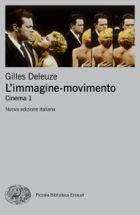
Gilles Deleuze - L'immagine-movimento (Cinema 1) - Einaudi, 2016 Nuova edizione (traduzione J.P. Manganaro)


Questo studio non è una storia del cinema. È una tassonomia, un tentativo di classificazione delle immagini e dei segni. Ma questo primo volume deve accontentarsi di determinare gli elementi, e soprattutto gli elementi di una sola parte della classificazione. Faremo spesso riferimento al logico americano Peirce (1839-1914), perché ha stabilito una classificazione generale delle immagini e dei segni che è indubbiamente la piú completa e la piú varia. È come una classificazione di Linneo in storia naturale o, meglio, una tavola di Mendeleev in chimica. Il cinema impone nuovi punti di vista su questo problema.
Un altro confronto si impone con pari forza. Nel 1896 Bergson scriveva Materia e memoria: era la diagnosi di una crisi della psicologia. Non si potevano piú opporre il movimento come realtà fisica nel mondo esterno e l’immagine come realtà psichica nella coscienza. La scoperta bergsoniana di un’immagine-movimento, e piú profondamente di un’immagine-tempo, conserva ancora oggi una tale ricchezza che forse non se ne sono tratte tutte le conseguenze. Malgrado la critica troppo sommaria che Bergson farà un po’ piú tardi del cinema, niente può impedire la congiunzione dell’immagine-movimento, quale egli la considera, e dell’immagine cinematografica.
In questa prima parte tratteremo dell’immagine-movimento e delle sue varietà. L’immagine-tempo sarà l’oggetto di una seconda parte. Ci è sembrato che i grandi autori di cinema avrebbero potuto essere paragonati non soltanto a pittori, architetti, musicisti, ma anche a pensatori. Essi, invece di pensare per concetti, pensano per immagini-movimento e immagini-tempo. La grande abbondanza di inconsistenza nella produzione cinematografica non rappresenta un’obiezione: essa non è peggiore che altrove, benché abbia conseguenze economiche e industriali non confrontabili. I grandi autori di cinema sono dunque soltanto piú vulnerabili, ed è infinitamente piú facile impedirgli di realizzare la loro opera. La storia del cinema è un lungo martirologio. Ciononostante il cinema fa parte della storia dell’arte e del pensiero, sotto le forme autonome insostituibili che questi autori hanno saputo inventare e, malgrado tutto, imporre. Non offriamo alcuna riproduzione che illustri il nostro testo, perché proprio il nostro testo vorrebbe essere un’illustrazione di grandi film di cui ognuno di noi serba piú o meno il ricordo, l’emozione o la percezione.
Dalla Premessa al volume
***
«Un libro di filosofia deve essere da un lato una specie particolarissima di romanzo poliziesco, dall’altro una sorta di fantascienza […]. Si avvicina il tempo in cui non sarà più possibile scrivere un libro di filosofia come se ne scrivono da un bel pezzo [...]. La ricerca di nuovi mezzi di espressione fu instaurata da Nietzsche, e deve essere oggi proseguita in relazione con il rinnovamento di altre arti, quali il teatro o il cinema».
Gilles Deleuze, Differenza e ripetizione

«C’è dunque questo libro unico, portatore di un gesto unico: Deleuze, un bel giorno, dopo aver visto molti film nella sua vita di filosofo, si decide a prendere in braccio il corpo del cinema, quasi un secolo di cinema, per tentare di dirne qualcosa, non solo perché avrebbe a sua volta, come altri, delle idee sul cinema, ma per riconsiderare a modo suo il campo del cinema. Questo presuppone uno sforzo straordinario e molto particolare, che intavoli sul vivo la questione del rapporto tra la filosofia e il cinema. Da una parte c’è la filosofia, molte volte definita da Deleuze come un'invenzione di concetti. Dall’altra c’è il cinema, che si tratta di pensare nella misura in cui già il cinema pensa, non solo grazie alla riflessività su se stesso di cui ha dato tanta prova, ma in quanto il cinema, come ogni arte, pensa di per sé attraverso i film dei grandi cineasti. 
[…]
La cosa stupefacente, emozionante di questo libro sta perciò nel provare a qual punto si è continuamente presi nella tassonomia, poiché i concetti si ordinano e progrediscono gli uni in rapporto agli altri, ma in proporzione al fatto che ogni concetto è immediatamente incarnato in un nome, nei corpi, in un’opera, in un corpo di opere o di epoche. L’immagine-pulsione, per seguire quest’esempio, mette dunque in gioco prima Stroheim, poi Buñuel, poi Losey, tutti e tre definiti con posizioni minuziosamente concatenate in un sistema rigido e aperto, simile a un colpo di dadi lanciato ogni volta in quella maniera strutturalista deviata e rivitalizzata, che costituisce il nucleo del pensiero di Deleuze e che diventa lo strumento dell’energia che lo alimenta. Un’altra cosa colpisce e sorregge la lettura: in questa storia nessun cineasta è mai oggetto di alcun giudizio di valore, se non quello che esce dalla classificazione e dalla genealogia».
Raymond Bellour, Pensare, raccontare. Il cinema di Gilles Deleuze
       [trad. it. di Raoul Kirchmayr, comparsa in «aut aut», 276/1996].
*** 
«Da un polo all’altro, lo spettatore di cinema trova infine qui, nel libro, ciò che provava là, seduto nella sala buia. Prova ciò che non può essere saputo quando si legge la sceneggiatura, né quando si parla del film, ancor meno quando si guarda un fotogramma, ma che viveva nell’immagine e nel tempo di quel momento. Ritrova dunque nel libro ciò che del cinema ogni film implica. Tale è la polarità dalla sala al libro. Ma, secondo la topologia del ripiegamento, lo spettatore nel libro apprende filosoficamente l’immagine e il tempo della vita, di cui la sala gli ha solo offerto l’esperienza».
François Regnault, La vie philosophique, «Magazine littéraire», 257, 1988.

5.5.16

Contact Festival @Apiary Studios, London, 6-8 May 2016


A festival of experimental film and video showing the work of over 70 artists/ filmmakers, featuring single-screen films, multi-screen/performance-related works and site-specific installations. Accompanied by a publication including discussion pieces by Luke Aspell and collective-iz (on collective practices), Sally Golding, James Holcombe and Cathy Rogers (on different manifestations of contemporary expanded cinema), and short essays by Maria Palacios Cruz (LUX, Deputy Director), William Fowler (BFI, curator of artists' moving image) and Nicky Hamlyn (filmmaker and writer), plus complete listings.

http://www.contactscreenings.co.ukhttp://www.contactscreenings.co.uk

The Contact festival is programmed by Andrew Vallance and Simon Payne. 

The festival opens on Friday 6th of May at 6pm. 

Installed works exhibited throughout the weekend:

Ian Bourn’s Cornered–2 Mirror Self Portrait; David Cunningham’s CMY; Louisa Fairclough’s Can People See Me Swallowing; Riccardo Iacono’s All For The Captured Time Of Our Being; Jamie Jenkinson’s Oscillating Fans; Conor Kelly’s Room Sound; Gareth Polmeer’s Field/Relation; Cathy Rogers' Between Here, There and This II, Francesco Tacchini and Oliver Smith’s The Network Ensemble; Mark Watson’s Protomoto CCTV; and Ian Wiblin’s City Circular 2016.

On Friday from 6pm, Saturday from 2pm and Sunday from 2pm we are showing single-screen films and expanded cinema/performance pieces at the following times.

Programme of single screen/performance/expanded works for Friday, Saturday and Sunday:

Friday

6pm 
Laura Hindmarsh Exposure Test

6:45 
Kerry Baldry Mumble and Punch
David Leister Blinder
Oliver Bancroft Sunday School with Rev'd Alfred Bissette

7:30
Bea Haut Passage
Jenny Baines Insertional

8:00
Karolina Raczynski and Anita Konarska Body Scan: [A]live Screening

8:30
John Smith Steve Hates Fish
Nick Collins Three Little Pieces

9:00
Sally Golding and Spatial


Saturday

2pm 
Emily Richardson Beach House
Patti Gaal-Holmes Liliesleaf Farm Mayibuye: Double Take

2:40
Jennet Thomas The Unspeakable Freedom Device

3:30
Steve Littman The Enlightenment – New Variations
Nicky Hamlyn Gasometers (Part 2)
Simon Payne Reason’s Code

4:15
George Barber Akula Dream

5:00
Maria Anastassiou Lightning Strikes
Jayne Parker and Joan Key Piano Performance for Tania Chen
Jennifer Nightingale Rectangle Window Arch Window

5:45
Amy Dickson North, South, East, West 

6:15
Mary Stark Film As Fabric

7:00
Małgorzata Drohomirecka Untitled
Samantha Rebello Midas (I)
Anna Thew Prometheus’ Stolen Time

7:45
Malcolm Le Grice The Probability of God is About Zero
Karen Mirza and Brad Butler Everything for Everyone and Nothing for Us

8:15
James Holcombe and Secluded Bronte Against Cinema

9:00
Lynn Loo Washi # 2 (extended version)
Guy Sherwin Looped Leaders


Sunday

2pm
Hilary Koob-Sassen Transcalar Investment Vehicles

3:00
Luke Aspell Alexander Berkman
Marek Budzynski A Little Bathroom Film
Adam Kossoff Fragmented Forest

3:30
Savinder Bual Agni
Matthew Noel-Todd Untitled (iPhone)
Heather Phillipson FINAL DAYS: UNDERWEAR

4:00
Daniel Brackenbury and Joe Gilmore Under Glass
Andrew Vallance Commonwealth Archipelago
Ben Rivers Things

5:00
Duncan Reekie Over and Over Again
William Raban Time And The Wave
Deniz Johns Media Blackout I

5:30
Francesco Tacchini and Oliver Smith The Network Ensemble

6:00
Steven Ball and Martin Blažíček More Speakers

6:45
Andrea Luka Zimmerman Towards Estate
Lis Rhodes Journal of Disbelief 

7:30
Laura Wilson 800 Lights in 177 years

8:00
Karel Doing Pattern/Chaos

8:30
Vicky Smith and Bouche Bée Primal 1

9:00
Greg Pope and Kostis Kilymis Cipher Screen 16

12.1.16

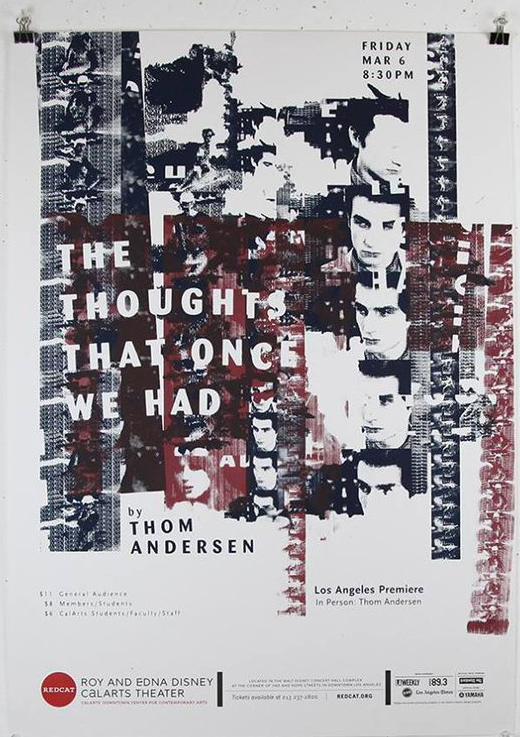
Not a Deleuze Lecture, but What? Thom Andersen’s The Thoughts That Once We Had by Peter Labuza @ Filmaker - 11 Mar, 2015


Not a Deleuze Lecture, but What? Thom Andersen’s The Thoughts That Once We Had

by Peter Labuza 


Read more HERE @ Filmaker website


I’ve heard many mistake the voiceover in Los Angeles Plays Itself as belonging to its writer-director Thom Andersen when it’s actually Encke King. A fair assumption — King speaks in a first person voiceover in a rather curmudgeonly monotone, fitting for the film’s occasionally cantankerous examination of the relationship between the physical spaces of Los Angeles and the way Hollywood films have portrayed them. The real Andersen is a more elusive character. His voice is more casual but less direct, his articulated knowledge of his own projects is tempered, bouncing around a given topic than directly addressing it. He pauses a lot as if he’s itching to get away from the crowds; he’d rather have the movies speak for him.

This might be problematic if you are going to speak at the world premiere of your new film, as Andersen did last Friday when The Thoughts That Once We Had played to a sold-out audience at Los Angeles’ REDCAT Theater. Los Angeles Plays Itself garnered the CalArts professor a cult reputation outside those who had seen his film history documentaries on Edward Muybridge (Zoopraxographer) or the blacklist (Red Hollywood). His newest project, however, is something much more indefinable, as well as exponential in scope: a personal vision of 20th century cinema refracted through the writings of philosopher Gilles Deleuze.

Even for hardcore cinephiles, understanding Deleuze is not an easy task, whose work is often relegated to graduate seminars and academic conferences. Those who have probably picked up Andre Bazin’s What Is Cinema? are much less likely to have paged through Deleuze’s Cinema 1 and Cinema 2. In academic cinema studies circles, Deleuze is an atom bomb — he entered film discourse in the late 1980s at a time when theoretical approaches to understanding cinema (the so-called “Grand Theory” tradition) were being upstaged by the new formalist methods developed by David Bordwell and Kristen Thompson. With his impossibly wordy prose, the French Deleuze also rejected the traditions of psycho-analytical and semiotic approaches to understanding cinema. In its place, however, he created a more elusive theory of cinema as a space where “thought” could be produced. His most famous thesis is his splitting of the history of cinema between the “action-image” (character-motivated action, defined by Classical Hollywood) and the “time-image” (contemplative cinema defined by filmmakers like Ozu and Antonioni). His work then becomes something of a grand synthesis of Bazinian realism, Brechtian discourse, Bergsonian philosophy, all written in a way that has captured passions of many scholars (and frustrated countless others).
At the premiere, Andersen attempted to downplay the influence of Deleuze on the work, commenting, “It’s not a lecture,” but the project evolved out of a yearly seminar he has taught on the film philosopher. The Thoughts That Once We Had (a title coming from the Christina Rossetti poem read in Kiss Me Deadly) isn’t a linear tour through Deleuze; Andersen called the quoted passages a “structuring device” for the director’s own history through the movies. It recalls Godard’s Histoire(s) du cinéma, but without the collage effect of the former work. Boldly, Andersen has forgone voiceover, a crucial element to his past films — the clips and textual quotes from Deleuze must speak for themselves.
The film begins with Deleuze’s “affection-image” and the faces of silent cinema — Griffith, Von Stroheim, Von Sternberg — which he weaves to those in Godard, Cassavetes, and Costa. Andersen then considers World War II through documentary images of the Siege of Leningrad and bombings in Vietnam (using footage from Joris Ivens’s 17th Parallel), before then highlighting the absence of these images in Alain Resnais’s Hiroshima Mon Amour. One of Andersen’s more successful bits is to remove the voice of the characters’ refrains (“You saw nothing in Hiroshima. Nothing”), instead using them as intertitles in communication with the images, the blank spaces acting as placeholders for the absent footage of the bomb.
If one of Los Angeles Plays Itself’s merits was its rigorous argumentative structure, The Thoughts That Once We Had prides itself on being a meandering look through the 20th century through film. There are clever connections — a scene of Jeanne Moreau walking through Paris streets in the 1960s is sewn to the opening of Hou Hsiao-Hsien’s Millennium Mambo, while Chaplin’s protest gag in Modern Times is juxtaposed with the wrongful conviction in Errol Morris’ The Thin Blue Line. These relationships are key to the Deleuze project, where cinema repeats certain gestures again and again, but in Andersen’s conception of them, they felt more like surface play.
More successful was a sequence demonstrating Deleuze’s concept of firstness, secondness, and thirdness through three comedies. Andersen quotes Deleuze’s strange schema: firstness is pure being (Harry Langdon’s turtle-paced comedy, emphasizing his blissful expression), secondness as the forces between objects (Laurel and Hardy’s gag wars, in which each action necessarily leads to the next), and thirdness as something as only existing in relation between firstness and secondness (the many double entendres, physical gags and mistaken identities of the Marx Brothers). Andersen then jumps to the violent murder at the end of Masahiro Shinoda’s Pale Flower (in place of Deleuze’s choice of Hitchcock) to show how the film’s murder works as an expression of all three states. However, my discussion with audience members unfamiliar with Deleuze after the screening indicated they found this sequence particularly hard to follow.
If the film isn’t a history lesson, what is it? It certainly showcases some of Andersen’s favorite films and filmmakers (he claimed his working title was Great Moments from the Cinema): American film noir, various Godard filmsa tribute to the “underrated” (according to Andersen) Marlon Brando, and Fritz Lang (the audience particularly ate up Debra Pagent’s erotic dance to a snake from his rather underknown two-part “Indian Epic,” The Tiger of Eschnapur and The Indian Tomb). The film ends with quotes from Deleuze’s hope to restore a “belief in the world” through cinema, using the “As Tears Go By” sequence from Made In U.S.A. But what does Andersen want his audiences to experience? During the Q&A, Andersen appeared anxious about the response, admitting, “I don’t understand the movie myself.” (.... Read full review @ The Filmaker website)

10.6.14

Internet machine by Timo Arnall, or why the cloud isn't in the air


Internet machine is a multi-screen film made by Timo Arnall about the invisible infrastructures of the internet. The film reveals the hidden materiality of data by exploring some of the machines through which ‘the Cloud’ is transmitted.

Read more.

25.12.13

Daniele Poccia: Chi è il mostro? 'District 9' di Neil Blomkamp @ Newstown, 23.12.2013


Daniele Poccia: Chi è il mostro? 'District 9' di Neil Blomkamp @ Newstown

In “District 9” di Neil Blomkamp, film di fantascienza dalla singolare potenza evocativa, lo spettatore assiste a una metamorfosi che non ha nulla di kafkiano – a meno di non vedere anche nel celebre racconto dello scrittore ceco una metafora squisitamente etico-politica. In entrambi i casi, il protagonista, in effetti, si ritrova repentinamente e involontariamente a incarnare in senso letterale un’alterità tanto più difficile da tollerare quanto lontana dal nostro stesso essere umani. In entrambi i casi, alla più ordinaria e anodina normalità subentra improvvisamente un inquietante divenire-mostro, a cui fa seguito una coatta quanto straniante conversione dello sguardo, un cambiamento di prospettiva, quale soltanto le più sfrenate speculazioni filosofiche e sperimentazioni letterarie sanno talvolta dare luogo davvero. Ma che cos’è, in senso proprio, un mostro? E in che misura, la mostruosità può produrre una visione inedita della realtà? Perché è questo che succede nel film in questione (così come, anche, per certi versi, nel testo di Kafka). Costretto da circostanze sostanzialmente enigmatiche (l’inalazione di uno strano fluido), un burocrate incaricato di dirigere lo sgombero di una derelitta comunità aliena insediata nella periferia di Johannesburg (dove l’ombra dell’apartheid è ancora presente…), si trova a passare da perfetta rappresentazione della “banalità del male” dello Stato contemporaneo a combattente, o addirittura “terrorista”, pronto a tutto pur di danneggiare il suo nemico. Si trova, in breve, a diventare da corresponsabile di un’operazione di tenore chiaramente autoritario e razzista a soggetto capace di risvegliare un “popolo” altrimenti deciso a rimanere inerme di fronte a ogni genere di angheria. Quasi che soltanto vivendo l’allucinante esperienza di chi abbandona, anche per poco, la propria identità, si possa veramente vedere lucidamente il mondo e, di conseguenza, agire affinché esso muti in meglio. Una volta il filosofo Gilles Deleuze ha scritto che non si pensa se non sotto l’effetto di urto o di un trauma, che il pensiero autentico sorge sempre in risposta a qualcosa di ingestibile e lesivo. Che, insomma, soltanto l’incontro e l’impatto con qualcosa di problematico risvegliano quella che egli stesso amava chiamare la “veggenza”, ovvero la capacità di cogliere ciò che innanzitutto resta celato, ciò in cui le stesse differenze di ogni tipo trovano la loro origine. Quale trauma maggiore allora che diventare il proprio altro e nemico? Quale ferita narcisistica altrettanto grave si può immaginare? Colui che, per cause che non dipendono da lui, si ritrova in questa circostanza, accede perciò alla consapevolezza – ben espressa dal medico e filosofo Georges Canguilhem – che il normale è soltanto il grado zero del mostruoso, ciò verso cui quest’ultimo tende asintoticamente senza poterci mai arrivare. Che, cioè, la “normalità” è un concetto funzionale e operativo e non, come si crede solitamente, descrittivo, un concetto forgiato al fine di operare concretamente distinzioni, di dirimere ciò che nel mondo appare caotico. Allo scopo, in una parola, di disciplinare il reale, anche umano. Ecco allora che, nello scambio delle parti, sono gli esseri umani – i “normali” – ad apparire come i veri mostri. Sono loro a essere osceni e inguardabili – come accadeva già in un vecchio film di John Carpenter, “Essi vivono”, dove, un proletario americano, venendo in possesso di magici occhiali, riusciva finalmente a vedere la realtà per quello che è veramente: capitalisti-zombie e manifesti pubblicitari che incitano apertamente all’obbedienza. O meglio, è la pretesa di poter stabilire dove inizia la mostruosità e finisce il normale a rivelarsi illusoria e politicamente compromessa in senso fascista. A monte di questa stessa partizione non vi è infatti un criterio oggettivo in grado di stabilire una volta per tutte chi è nel giusto e chi, invece, no – per un motivo o per un altro. Alle sue spalle, non esiste un termine di paragone – un paradigma – a partire dal quale sceverare il grano dal loglio, come si suol dire. Dietro di lei, vi è piuttosto quella capacità, propria di un organismo davvero sano, di inventare da sé le sue norme – capacità che sempre Canguilhem definiva “normatività”, intendendo con ciò una dinamica che non implica l’adeguazione a regole già date, ma la loro costante e autonoma revisione. Vi è, insomma, la capacità non tanto di adattarsi a ciò che ci circonda, ma di plasmarlo piuttosto attivamente in funzione delle nostre esigenze. In quest’ottica, allora, ciò che in un primo tempo può apparire mostruoso o intollerabile, può in un secondo momento diventare il punto di partenza di qualcosa di radicalmente nuovo, come d’altronde la stessa evoluzione biologica insegna. L’idea, infatti, che l’evoluzione delle specie sia soltanto il risultato di un passivo adattamento all’ambiente – che elimina i più deboli e favorisce i più forti –, l’idea della fitness, è non solo politicamente discutibile quando, col darwinismo sociale, è applicata alle comunità degli uomini, ma anche scientificamente poco esplicativa. Si deve a Stephen Jay Gould, un paleontologo, l’introduzione di un concetto, quello di “esattamento” (exaptation), che mostra finalmente come non tutto, nel mondo vivente, sia il risultato di un perfetta corrispondenza tra caratteri morfo-funzionali organici e fattori ambientali. Come, in altri termini, molte strutture caratteristiche di un organismo risultino derivatamente da altre, come una sorta di avanzo non progettuale, di spazi di risulta che, nonostante ciò, sussistono e che, magari, potranno essere cooptati solo successivamente in configurazioni adattative. Il che è come dire che, a volte, un certo grado di disadattamento è necessario al cambiamento, e che, anzi, è in esso che risiedono spesso le risorse più grandi. Il metodo dell’evoluzione, come è stato più volte detto (da François Jacob, per esempio), non è infatti quello dell’ingegnere che tutto deve prevedere e che tutto deve organizzare secondo le sue intenzioni, ma quello del bricoleur, che se la cava con ciò che trova e al quale spesso, se non sempre, avanzano dei pezzi di cui si servirà soltanto in futuro. Le forme di vita sono cioè il risultato sempre rivedibile di un processo che non ha scopi, che procede anarchicamente e orizzontalmente (senza presupporre un vertice che ne controlla la vicenda). Ognuno di noi, allora, si trova potenzialmente nella condizione del protagonista di “District 9”. Ognuno di noi deve sapere che la sua appartenenza a questo o a quel gruppo – per quanto significativa – non è mai integrale. Nessuno è mai interamente suturato ad un certa identità, in senso proprio “normale”, potendo sempre diventare il mostro che teme. È solo anzi nella misura in cui ci si colloca in questa stessa apertura priva di nomi e di figure date una volta per tutte, in quel luogo che eccede ogni identità, che si può forse, meglio che altrove, provare a esercitare il proprio diritto a plasmare il mondo e, magari, a migliorarlo veramente. È solo nella misura in cui si sa che il mostro non è mai davvero così lontano ed eccentrico, che si può sperare di non diventare un “mostro” nel senso etico e politico della parola. È solo, insomma, accettando l’idea che la mostruosità ci abita sin da sempre, che si può davvero fare massa critica – senza riferimenti di classe o di altro – e sgominare chi sull’attribuzione delle identità costruisce il proprio dominio, ancora più pervasivo nelle odierne società del controllo dove è richiesto incessantemente di identificarsi. Fin quando infatti si vuole essere riconosciuti come rappresentati di un determinato segmento dell’umanità ci sarà sempre non soltanto il modo di esserlo, ma anche, inevitabilmente, di trovare nuove catene. Chi pretende di avere un nome proprio (etnico, ideologico, sessuale, ecc.), che lo individua nella sua anche specifica “normalità”, a ben vedere, è purtroppo sempre disponibile a farsi assoggettare, e ad assoggettare gli altri, per vederlo finalmente accettato.

Read more

26.11.13

Crimea X meets Carpenter @ Rosebud Cinema, RE/ITA, mercoledì 27 novembre 2013


MERCOLEDÌ 27 NOVEMBRE
ore 21.00
CRIMEA X MEETS CARPENTER
con DJ Rocca e Jukka Reverberi

Un feticcio per gli appassionati di soundtracks e musica elettronica: le composizioni create da John Carpenter, assieme ad Alan Howarth, ad accompagnamento delle pellicole dai lui stesso girate tra fine anni Settanta ed inizio anni Ottanta.
Un monumentale lavoro di minimalismo sintetico che ha segnato la storia della musica negli anni a venire.
Il duo reggiano Crimea X - DJ Rocca e Jukka Reverberi - reinterpreta le musiche di alcuni capolavori di John Carpenter scelti ed editati dal regista Mateo Zoni: "Distretto 13, Le brigate della morte"; "1997 fuga da New York"; "Christine, la macchina infernale"; e "The Fog" ed è subito incubo sintetico!

11.11.13

Beauty of mathematics by Yann Pineill & Nicolas Lefaucheux

"Mathematics, rightly viewed, possesses not only truth, but supreme beauty — a beauty cold and austere, without the gorgeous trappings of painting or music." —Bertrand Russell By Yann Pineill & Nicolas Lefaucheux

14.10.13

An interview with Nick Davis on 'The Desiring-Image' by Tim Brayton @ The Film Experience


An interview with Nick Davis, on "The Desiring-Image" by Tim Brayton
@ The Film Experience - 27.Jun.2013 + Read more


Just in time for Gay Pride Month, sometime Film Experience contributor and generally terrific film writer Nick Davis had his very first book published, The Desiring-Image: Gilles Deleuze and Contemporary Queer Cinema. After having torn through my copy a little bit faster than the densely academic arguments necessarily deserved, I sat down with Nick to chat about some aspects of the book.
(Disclosure: not only are Nick and I friends, I make an appearance in the acknowledgements, as does Nathaniel, our host. But that’s why this isn’t a “review”)
Tim Brayton: Just to clarify: for you and for the book, “queer theory” and “queer cinema” is complementary to, but not necessarily the same as, gay and lesbian cinema.
Nick Davis: Yes. “Queer” both as a scholarly term, and a term that filmmakers are using for their work, is sort of bringing a more political edge to gay or lesbian or bisexual storylines, and doing so in such a way that it’s hard to talk about sexuality without also talking about other forces and other aspects of your social situation that impact who you relate to, how, what you know about yourself, whether you think you have a sexuality, or whether it’s something that changes or goes by another name.
TB: The book is an investigation into queer theory and the writing of Gilles Deleuze, using them to comment on each other. I gather that Deleuze is not somebody who crops up often in queer discussion very much, so what started you on this line of thought?
ND: Probably two moments... One was being a senior in college, reading this article in Film Comment that was specifically objecting to how this specific queer cinema of the early ‘90s, that had brought us My Own Private Idaho, and Poison, and The Living End, and Paris Is Burning, by the end of the ‘90s to this author was feeling totally de-politicized, uninteresting, and abstract. Just as a magazine reader and as a filmgoer, I felt so excited and challenged by things opening at the same time, that I just didn’t believe him, but it was when I realized that there were a whole lot of filmgoers and scholars out there who were really invested in a specific set of directors continuing to do the same thing that they had done ten years ago. And it turned that what I had been excited about those early ‘90s movies was that they did not feel predictable. So that was what gave me the idea to write against the idea that this trend had died, that it might be feel a lot more like a French New Wave, or something where you know what the movies are that get it going, but it’s not the point for it to stay the same for five or ten years.


And the other moment was in the middle of grad school, when I read those two Gilles Deleuze theory books, Cinema 1 and Cinema 2, and those books so notoriously difficult, and so weird with what they call things, but unlike a lot of film theorists and I dare say even a lot of film scholars, they were written by somebody who went to the movies all the time, and wanted to have an idea about how different movies are from one another. So it was a great challenge to understand those books, and then try to imagine myself as teaching those books to other people, and then it felt like the crossover of how he thought about film, how I thought about desire, even how he thinks about desire in other books that are not about film, that that would be an exciting topic.
TB: One of your main case studies is a pair of David Cronenberg films, read through two Deleuzian filters. As you point out several times in the book, Cronenberg is straight, and has traditionally been seen as antagonistic by queer scholars. How did you come to the realization that what he was doing was in the wheelhouse of queer cinema?
ND: When I saw Crash (1996) twice on opening weekend and felt like a big perv for wanting to see Crash twice on opening weekend. And that came out within a year of my own coming-out, and trying to explain even to my parents and my friends, “I’m not sure ‘gay’ is a great word for what I’m telling you I am, there are women and men that I would happily be in relationships with, and… I’m telling you I’m not straight, is what I’m telling you.”
What Crash, as fucked-up as it is as a movie, was saying, was who even knows why this is what these people want to do, they each have a variety of partners that don’t remind you of each other. So that was the first inspiration, to think of Cronbenberg as doing this, and later, when he became part of the project, it was actually because I was critiquing myself, because the first version of the Cronenberg material was a grad school seminar essay in which I argue exactly the points I argue against in this. I realized my own hypocrisy, maybe, because what he was doing was so envelope-pushing and challenging about whatanybody thinks that desire is, that the sheer impact of recruiting him as a potentially queer filmmaker would get the book out on a solid note, of “don’t assume anything about anybody.” And also I didn’t just want to critique what other people have thought that I don’t agree with, I wanted to critique myself, for what I used to think.


TB: Have you gotten any pushback?
ND: There’ve been interesting conversations...I met Peter Weller at a celebration of the novel Naked Lunch’s 50th anniversary, which was here in Chicago. And I told him I was working on this, and the minute I said, “I’m writing a book about queer cinema, and I start with Naked Lunch and Dead Ringers,” he said, “Do not do that. William Burroughs would have hated to be grouped as a gay filmmaker. He was not about identity politics and labels.” And I said, this is exactly what I wanted to dismantle about the way we think about Cronenberg and Burroughs, because I think he’s exactly the wrong writer and this is exactly the wrong movie to go looking for a role modeling of what gay desire looks like. And he got so excited. So that was an awesome moment of understanding what the rejection might be, and then feeling fortified.
Tim Brayton: As you discuss Velvet Goldmine, you introduce the idea that it was identified in 1998 as a dead end for queer cinema, and your response is to not only challenge that, but suggest that the film itself challenges that. Do you believe there is or was an orthodoxy in queer studies that films like that are contesting?
Nick Davis: I think in some ways that the theorists have been less prone to their own orthodoxy than people who write about the queer movies. I think the temptation to want Gus Van Sant to keep making gay avant-garde cinema was stronger in some ways than the need for queer theory to not evolve. But it’s probably something of a taste issue. I like movies that are non-dogmatic about who your allies are, who you might desire, what you might desire. So a lot of the later movies in the book, like Brother to Brother or Shortbus, I think do pose really exciting questions: do we even know who we are as a queer community, where does sexuality fall on some kind of ranked list of my priorities. Velvet Goldmine is last in the book, partially because I think it’s the most exciting… it doesn’t end really hopefully, it doesn’t end really pessimistically, it doesn’t give you a clear idea of who’s with you and who’s against you, it challenges you to think about that in a really big way. So I think a lot of the movies that excite me – Beau travail is this way also – do open up, get you out of a reflexive answer about that.

TB: Regarding Beau Travail, the book argues that the understanding of that film as “queer” is somewhat problematic, that it was forced onto it by outside marketing forces. Do you believe that it is queer?
ND: I totally do, but I think my sense of it… it’s the only movie in the book that I really didn’t like the first time I saw it. And then again, it was a case of understanding that it was just fundamentally different than what I expected the movie to be, which was a legible adaptation of Billy Budd.
I feel like… if you open a newspaper, and you see an ad for a bar, or a club, and it has a bare-chested really muscled guy on the front of it, suddenly it’s just clear that’s a gay club. In the same way, I think because our relationships to male bodies in movies have been so postponed, for such a long time, making them available as something to take pleasure in, that it feels weirdly backwards to associate muscled, good-looking guys with one idea. Most movies that are full of that many barely-dressed, worked-out guys, are doing that to awaken a lot of erotic tension among them, which seems like exactly what’s missing in that movie. When you start to associate homoeroticness, or queerness, or gayness with being super-buff and bare-chested, and that leaves out most of us, I think there’s a reason to disentangle that as an equation.

TB: What are your thoughts on the current state of queer cinema?
ND:  My sense is that it’s probably someplace like where black cinema is, or women’s cinema, that it is now so hydra-headed, and works in so many ways, that it’s hard to take stock of how it’s doing right now, which was part of what was exciting about it. To me, that was part of the success story, how you often need a moment where there’s a huge push of really vigorous, challenging work, that you can ask at the end of ten years, how is the New Queer Cinema looking these days, and I felt more optimistic than people tended to at the end of ten years. There’s so many movies made around the world, or even at home- you know, like, in a Mulholland Dr. era, where there can be clearly telegraphed homoeroticism in a movie, but your impulse to call it queer cinema may be strong or weak. So my sense of it is just that it’s moved in a whole lot of directions, and to me that’s actually healthy, even though I understand the nostalgia for seeing it out and proud.
There was this full article in, I think The Guardian last year, about Weekend, and Keep the Lights On, and I Want Your Love, about seeing a collection of movies that were working as excitingly with total naturalism, as these early ‘90s movies were working with the opposite of that, with post-modernism and structural play. So I bet we’ll see ups and downs, it will feel like there are discrete movements where a few filmmakers are gravitating toward each other and doing something new again, and I’ll be excited for that also, but I also like these periods of diffusion.
Pic Post: William-Adolphe Bouguereau "Inferno