15.10.13
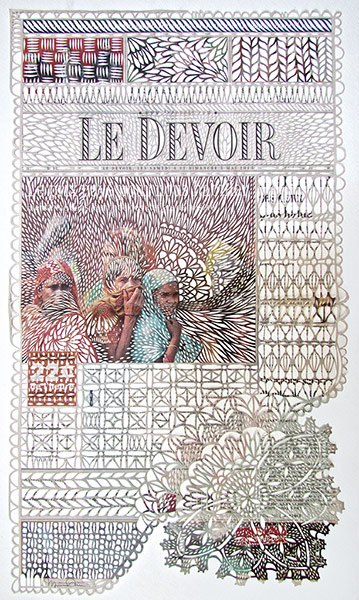
Myriam Dion and the fragile beauty of newsprint – in pictures @ The Guardian, 13.Oct.2013

Myriam Dion and the fragile beauty of newsprint – in pictures
@ The Guardian Read more
Myriam Dion is the first to admit that she makes her choice of newspaper each day based on the pictures. For this French-Canadian student is also a papercut artist, whose carefully cut-out newspaper pages have won numerous awards. Dion works freehand using a scalpel to produce these beautiful designs reminiscent of both Arabic latticework and stained-glass windows. She suggests that the transformation from broadsheet to objet d'art is "to find a new use for print media in the process of its disappearance", and the delicate quality of her work may well be a subtle mirroring of the fragile state of print journalism.


14.10.13
An interview with Nick Davis on 'The Desiring-Image' by Tim Brayton @ The Film Experience

An interview with Nick Davis, on "The Desiring-Image" by Tim Brayton
@ The Film Experience - 27.Jun.2013 + Read more
Just in time for Gay Pride Month, sometime Film Experience contributor and generally terrific film writer Nick Davis had his very first book published, The Desiring-Image: Gilles Deleuze and Contemporary Queer Cinema. After having torn through my copy a little bit faster than the densely academic arguments necessarily deserved, I sat down with Nick to chat about some aspects of the book.
(Disclosure: not only are Nick and I friends, I make an appearance in the acknowledgements, as does Nathaniel, our host. But that’s why this isn’t a “review”)
Tim Brayton: Just to clarify: for you and for the book, “queer theory” and “queer cinema” is complementary to, but not necessarily the same as, gay and lesbian cinema.
Nick Davis: Yes. “Queer” both as a scholarly term, and a term that filmmakers are using for their work, is sort of bringing a more political edge to gay or lesbian or bisexual storylines, and doing so in such a way that it’s hard to talk about sexuality without also talking about other forces and other aspects of your social situation that impact who you relate to, how, what you know about yourself, whether you think you have a sexuality, or whether it’s something that changes or goes by another name.
TB: The book is an investigation into queer theory and the writing of Gilles Deleuze, using them to comment on each other. I gather that Deleuze is not somebody who crops up often in queer discussion very much, so what started you on this line of thought?
ND: Probably two moments... One was being a senior in college, reading this article in Film Comment that was specifically objecting to how this specific queer cinema of the early ‘90s, that had brought us My Own Private Idaho, and Poison, and The Living End, and Paris Is Burning, by the end of the ‘90s to this author was feeling totally de-politicized, uninteresting, and abstract. Just as a magazine reader and as a filmgoer, I felt so excited and challenged by things opening at the same time, that I just didn’t believe him, but it was when I realized that there were a whole lot of filmgoers and scholars out there who were really invested in a specific set of directors continuing to do the same thing that they had done ten years ago. And it turned that what I had been excited about those early ‘90s movies was that they did not feel predictable. So that was what gave me the idea to write against the idea that this trend had died, that it might be feel a lot more like a French New Wave, or something where you know what the movies are that get it going, but it’s not the point for it to stay the same for five or ten years.
And the other moment was in the middle of grad school, when I read those two Gilles Deleuze theory books, Cinema 1 and Cinema 2, and those books so notoriously difficult, and so weird with what they call things, but unlike a lot of film theorists and I dare say even a lot of film scholars, they were written by somebody who went to the movies all the time, and wanted to have an idea about how different movies are from one another. So it was a great challenge to understand those books, and then try to imagine myself as teaching those books to other people, and then it felt like the crossover of how he thought about film, how I thought about desire, even how he thinks about desire in other books that are not about film, that that would be an exciting topic.
TB: One of your main case studies is a pair of David Cronenberg films, read through two Deleuzian filters. As you point out several times in the book, Cronenberg is straight, and has traditionally been seen as antagonistic by queer scholars. How did you come to the realization that what he was doing was in the wheelhouse of queer cinema?
ND: When I saw Crash (1996) twice on opening weekend and felt like a big perv for wanting to see Crash twice on opening weekend. And that came out within a year of my own coming-out, and trying to explain even to my parents and my friends, “I’m not sure ‘gay’ is a great word for what I’m telling you I am, there are women and men that I would happily be in relationships with, and… I’m telling you I’m not straight, is what I’m telling you.”
What Crash, as fucked-up as it is as a movie, was saying, was who even knows why this is what these people want to do, they each have a variety of partners that don’t remind you of each other. So that was the first inspiration, to think of Cronbenberg as doing this, and later, when he became part of the project, it was actually because I was critiquing myself, because the first version of the Cronenberg material was a grad school seminar essay in which I argue exactly the points I argue against in this. I realized my own hypocrisy, maybe, because what he was doing was so envelope-pushing and challenging about whatanybody thinks that desire is, that the sheer impact of recruiting him as a potentially queer filmmaker would get the book out on a solid note, of “don’t assume anything about anybody.” And also I didn’t just want to critique what other people have thought that I don’t agree with, I wanted to critique myself, for what I used to think.
TB: Have you gotten any pushback?
ND: There’ve been interesting conversations...I met Peter Weller at a celebration of the novel Naked Lunch’s 50th anniversary, which was here in Chicago. And I told him I was working on this, and the minute I said, “I’m writing a book about queer cinema, and I start with Naked Lunch and Dead Ringers,” he said, “Do not do that. William Burroughs would have hated to be grouped as a gay filmmaker. He was not about identity politics and labels.” And I said, this is exactly what I wanted to dismantle about the way we think about Cronenberg and Burroughs, because I think he’s exactly the wrong writer and this is exactly the wrong movie to go looking for a role modeling of what gay desire looks like. And he got so excited. So that was an awesome moment of understanding what the rejection might be, and then feeling fortified.
Tim Brayton: As you discuss Velvet Goldmine, you introduce the idea that it was identified in 1998 as a dead end for queer cinema, and your response is to not only challenge that, but suggest that the film itself challenges that. Do you believe there is or was an orthodoxy in queer studies that films like that are contesting?
Nick Davis: I think in some ways that the theorists have been less prone to their own orthodoxy than people who write about the queer movies. I think the temptation to want Gus Van Sant to keep making gay avant-garde cinema was stronger in some ways than the need for queer theory to not evolve. But it’s probably something of a taste issue. I like movies that are non-dogmatic about who your allies are, who you might desire, what you might desire. So a lot of the later movies in the book, like Brother to Brother or Shortbus, I think do pose really exciting questions: do we even know who we are as a queer community, where does sexuality fall on some kind of ranked list of my priorities. Velvet Goldmine is last in the book, partially because I think it’s the most exciting… it doesn’t end really hopefully, it doesn’t end really pessimistically, it doesn’t give you a clear idea of who’s with you and who’s against you, it challenges you to think about that in a really big way. So I think a lot of the movies that excite me – Beau travail is this way also – do open up, get you out of a reflexive answer about that.
TB: Regarding Beau Travail, the book argues that the understanding of that film as “queer” is somewhat problematic, that it was forced onto it by outside marketing forces. Do you believe that it is queer?
ND: I totally do, but I think my sense of it… it’s the only movie in the book that I really didn’t like the first time I saw it. And then again, it was a case of understanding that it was just fundamentally different than what I expected the movie to be, which was a legible adaptation of Billy Budd.
TB: What are your thoughts on the current state of queer cinema?
ND: My sense is that it’s probably someplace like where black cinema is, or women’s cinema, that it is now so hydra-headed, and works in so many ways, that it’s hard to take stock of how it’s doing right now, which was part of what was exciting about it. To me, that was part of the success story, how you often need a moment where there’s a huge push of really vigorous, challenging work, that you can ask at the end of ten years, how is the New Queer Cinema looking these days, and I felt more optimistic than people tended to at the end of ten years. There’s so many movies made around the world, or even at home- you know, like, in a Mulholland Dr. era, where there can be clearly telegraphed homoeroticism in a movie, but your impulse to call it queer cinema may be strong or weak. So my sense of it is just that it’s moved in a whole lot of directions, and to me that’s actually healthy, even though I understand the nostalgia for seeing it out and proud.
There was this full article in, I think The Guardian last year, about Weekend, and Keep the Lights On, and I Want Your Love, about seeing a collection of movies that were working as excitingly with total naturalism, as these early ‘90s movies were working with the opposite of that, with post-modernism and structural play. So I bet we’ll see ups and downs, it will feel like there are discrete movements where a few filmmakers are gravitating toward each other and doing something new again, and I’ll be excited for that also, but I also like these periods of diffusion.
Pic Post: William-Adolphe Bouguereau "Inferno
Breaking: US nearly detonated atomic bomb over North Carolina
A secret document, published in declassified form by the Guardian, reveals that the US Air Force came dramatically close to detonating an atom bomb over North Carolina that would have been 260 times more powerful than the device that devastated Hiroshima.
Read it here. Good morning.

Read it here. Good morning.
Nick Davis: The Desiring-Image: Gilles Deleuze and Contemporary Queer Cinema - Oxford University Press, July 2013

The Desiring-Image yields new models of queer cinema produced since the late 1980s, based on close formal analysis of diverse films as well as innovative contributions to current film theory. The book defines "queer cinema" less as a specific genre or in terms of gay and lesbian identity, but more broadly as a kind of filmmaking that conveys sexual desire and orientation as potentially fluid within any individual's experience, and as forces that can therefore unite unlikely groups of people along new lines, socially, sexually, or politically. The films driving this analysis range from celebrated fixtures of the New Queer Cinema of the 1990s (including Cheryl Dunye's The Watermelon Woman and Todd Haynes's Velvet Goldmine) to sexually provocative films of the same era that are rarely classified as queer (David Cronenberg's Dead Ringers and Naked Lunch) to breakout films by 21st-century directors (Rodney Evans's Brother to Brother, John Cameron Mitchell's Shortbus). To frame these readings and to avoid heterosexist assumptions in other forms of film analysis, The Desiring-Image revisits the work of the philosopher Gilles Deleuze, whose two major works on cinema somehow never address the radical ideas about desire he expresses in other texts. This book brings those notions together in innovative ways, making them clear and accessible to newcomers and field specialists alike, with clear, illustrated examples drawn from a wide range of movies extending beyond the central case studies. Thus, The Desiring-Image speaks to readers interested in queer and gay/lesbian studies, in film theory, in feminist and sexuality scholarship, and in theory and philosophy, putting those discourses into rich, surprising conversations with popular cinema of the last 30 years.
Table of Contents:
Introduction: The Desiring Image
The Triple Womb
Queering the Cinema Books
New Queer Is . . . New Queer Ain't
Seven Pillars of Schizo Homo Pomo
A Word on Orientation, or Around 1991
Preview of Coming Attractions
1. "Beyond Gay": Dead Ringers and Queer Perceptions
"We're Just Not Sure What Kind It Is"
Dissenting from "A Dissenting View"
Mutant Textuality
Perceptions of Perception: Movement, Time, Subtraction
Perceptions and Desire: Types of Flows
Out-of-Fields and the Desiring-Image
The Desiring-Images of Dead Ringers
First Out-of-Field: The Mantles vs. the World
Second Out-of-Field: The Love that Keeps Almost Speaking Its Name
Third Out-of-Field: The Triple-Womb and the "Either . . . or . . . or . . ."
Fourth Out-of-Field: Impulse and Immanence
The Desiring-Image as Relation-Image
2. Hard Bodies and Sex-Blobs: Deterritorializing Desire in Naked Lunch and Shortbus
Innaresting Sex Arrangements
Peaks, Sheets, and Series
"Everything Is Permitted": Incompossibilities of Desire
Schizos and Counterpublics
If on a Summer's Night a Sex-Blob
Sounds, Stutters, and Scatterplots
A Kafka High or a New Low?: Quandaries of the Minor
Shortbus: The Queer Politics of "Actual" Sex
Does This Bus Only Make One Stop?
3. "Something in Her Face": Queering the Affection-Image in The Watermelon Woman
Who Is She, and What Is She to You?
The Riddle of the Lesbian Affection-Image
Like Clockwork, or How to Make a Face
Facing Elsie, and the Mystery of the Other Person
Black Lesbians and Their Others
Peaks of Present, or What Ever Happened to Lesbian Community?
Sheets of Past and Centers of Indetermination
A Singular Face, Implying Multitudes
Deflective Unities and Oracular Chores
Faces in the Crowd
Facing Forward
4. Brother to Brother and Adventures in Queer Crystallography
Queer Crystallography
Crystals, Then and Now
The Four Types
Looking for Bruce / Looking for Perry
Through a Crystal-Image, Darkly
What's Sex Got to Do with It?
5. Crystal-Queer Economies: Beau Travail
What's Money Got to Do with It?
The Oyster and the Book in Blood
The Broken Compass and the Three Economies
Beau travail, or the Ambiguities
Compound Crystals
Bachelors and Belles transitions
6. Theses on a Philosophy of Queer History: Velvet GoldmineChanging the World / Changing Ourselves
Angels, Aliens, and Orphans
Point A to Point B
Wild Cards and Unexpected Critiques
Toward Productive Ends
The Minors and the Miners
Nick Davis is Associate Professor of English and Gender & Sexuality Studies at Northwestern University.
"The Desiring-Image is high concept: it adds a third term to 'movement-image' and 'time-image,' extending Deleuze's inquiry into present-day world cinema and making his pair of cinema books a trilogy. It is also high theory. Yet Davis's book is also concrete and accessible, explaining and synthesizing Deleuzian terminology and illuminating key works of New Queer Cinema in ways that renew their promise for critical inquiry, pedagogy, and film culture. The clarity of Davis's prose does not diminish the text's rhetorical performance, which is sustained and often dazzling." — Patricia White, author of Uninvited: Classical Hollywood Cinema and Lesbian Representability
"This is important and needed work. Davis' deeply original move is to fold Deleuze's film concepts into the Anti-Oedipus and to remap them, and in so doing to produce a distinctly original perspective for assessing and revaluing the films that inspire him. The Desiring-Imagehas renewed and extended Deleuze's concepts in ways that will encourage the formation of new perspectives and forms of analysis for cinema, queer or otherwise."--D.N. Rodowick, author of The Virtual Life of Film
"The Desiring-Image brings an exciting new perspective on film and desire. Impressive, at times startling in its groundbreaking originality, The Desiring-Image will stimulate anyone interested in how cinema produces the desire which shapes the worlds we inhabit."--David Martin-Jones, author of Deleuze and World Cinemas
"At its best, Nick Davis' The Desiring-Image thinks through Deleuze to explode our conception of the queer cinema canon, to challenge our understanding of homoeroticism, and to consider the ways queer cinema imagined itself in retrospect. This is an exhaustive yet lovingly written perverse intervention into film theory."--Lucas Hilderbrand, author of Inherent Vice: Bootleg Histories of Videotape and Copyright
"Seductive in its intellect and humbling in its prose, The Desiring-Image marks an important new entry into queer film studies and film theory more broadly. Queering Deleuze and 'deleuzing' queer film, Nick Davis' 'deterritorializing' treatise revives the radicalism and hope of both new queer cinema and the scholarship surrounding it."--Michele Aaron, editor of New Queer Cinema: A Critical Reader.
Read more on OUP
Read more on OUP