31.5.16

OUT NOW! - MONETA, RIVOLUZIONE E FILOSOFIA DELL'AVVENIRE (RIZOSFERA/OBSOLETE CAPITALISM FREE PRESS, 2016) - E.book 4 Free Download


E' finalmente disponibile online l'antologia e.book curata dal collettivo Obsolete Capitalism e intitolata «Moneta, rivoluzione e filosofia dell'avvenire. Nietzsche e la politica accelerazionista in Deleuze, Foucault, Guattari, Klossowski» (Edizioni Rizosfera/Obsolete Capitalism Free Press, 2016).

Gli autori sono: Algorithmic Committee, Sara Baranzoni, Edmund Berger, Lapo Berti, Paolo Davoli, Ettore Lancellotti, Network Ensemble, Obsolete Capitalism, Obsolete Capitalism Sound System, Letizia Rustichelli, Francesco Tacchini, Paolo Vignola. 


CLICCA QUI PER SCARICARE/ FREE DOWNLOAD


Moneta, rivoluzione e filosofia dell’avvenire
a cura di Obsolete Capitalism


Siamo proiettati a velocità fotonica nella comunicazione istantanea e nel controllo continuo mentre le forme di dominio rapido appaiono inarrestabili. Il museo delle ideologie si riempie di concetti in via di esaurimento quali capitalismo, neoliberismo, marxismo, keynesismo. Ora, con più esattezza, il sistema modula i vari flussi che innervano il pianeta: Moneta, Ricerca, Controllo, Informazione, Circuito sono i vecchi nomi che attraverso una nuova velocità producono potere. Maggiore è l’immanenza del Mercato, maggiore è la probabilità che al conflitto si sostituisca l’interruzione, il virus, la fuga di notizie, l’invisibilità, il fuori-circuito, la biforcazione. Uno squarcio nella «zona grigia» dell’egemonia.


Gli autori del libro Moneta, rivoluzione e filosofia dell’avvenire indagano alcune aree poco battute di politica accelerazionista attraverso linee teoriche contagiate dalle filosofie più visionarie: Nietzsche, Klossowski, Deleuze, Guattari, Foucault. Più che analizzare la grande trasformazione culturale in atto, la presente antologia evidenzia i pericoli in cui incorre il pensiero del futuro quando ancora mantiene pratiche, schemi e linguaggi di un’epoca industriale e post-industriale che mostra in tutti i suoi aspetti una crisi perpetua. Siamo tutti coinvolti nel duro intreccio di liberazioni insperate e nuovi asservimenti che ci prospetta la presentificazione del futuro da parte della tecnologia a linguaggio numerico, ma - come afferma Deleuze - «non è il caso né di avere paura, né di sperare, bisogna cercare nuove armi». Sperimentare è dunque il primo impegno politico e filosofico per un futuro differente.

5.5.16

Contact Festival @Apiary Studios, London, 6-8 May 2016


A festival of experimental film and video showing the work of over 70 artists/ filmmakers, featuring single-screen films, multi-screen/performance-related works and site-specific installations. Accompanied by a publication including discussion pieces by Luke Aspell and collective-iz (on collective practices), Sally Golding, James Holcombe and Cathy Rogers (on different manifestations of contemporary expanded cinema), and short essays by Maria Palacios Cruz (LUX, Deputy Director), William Fowler (BFI, curator of artists' moving image) and Nicky Hamlyn (filmmaker and writer), plus complete listings.

http://www.contactscreenings.co.ukhttp://www.contactscreenings.co.uk

The Contact festival is programmed by Andrew Vallance and Simon Payne. 

The festival opens on Friday 6th of May at 6pm. 

Installed works exhibited throughout the weekend:

Ian Bourn’s Cornered–2 Mirror Self Portrait; David Cunningham’s CMY; Louisa Fairclough’s Can People See Me Swallowing; Riccardo Iacono’s All For The Captured Time Of Our Being; Jamie Jenkinson’s Oscillating Fans; Conor Kelly’s Room Sound; Gareth Polmeer’s Field/Relation; Cathy Rogers' Between Here, There and This II, Francesco Tacchini and Oliver Smith’s The Network Ensemble; Mark Watson’s Protomoto CCTV; and Ian Wiblin’s City Circular 2016.

On Friday from 6pm, Saturday from 2pm and Sunday from 2pm we are showing single-screen films and expanded cinema/performance pieces at the following times.

Programme of single screen/performance/expanded works for Friday, Saturday and Sunday:

Friday

6pm 
Laura Hindmarsh Exposure Test

6:45 
Kerry Baldry Mumble and Punch
David Leister Blinder
Oliver Bancroft Sunday School with Rev'd Alfred Bissette

7:30
Bea Haut Passage
Jenny Baines Insertional

8:00
Karolina Raczynski and Anita Konarska Body Scan: [A]live Screening

8:30
John Smith Steve Hates Fish
Nick Collins Three Little Pieces

9:00
Sally Golding and Spatial


Saturday

2pm 
Emily Richardson Beach House
Patti Gaal-Holmes Liliesleaf Farm Mayibuye: Double Take

2:40
Jennet Thomas The Unspeakable Freedom Device

3:30
Steve Littman The Enlightenment – New Variations
Nicky Hamlyn Gasometers (Part 2)
Simon Payne Reason’s Code

4:15
George Barber Akula Dream

5:00
Maria Anastassiou Lightning Strikes
Jayne Parker and Joan Key Piano Performance for Tania Chen
Jennifer Nightingale Rectangle Window Arch Window

5:45
Amy Dickson North, South, East, West 

6:15
Mary Stark Film As Fabric

7:00
Małgorzata Drohomirecka Untitled
Samantha Rebello Midas (I)
Anna Thew Prometheus’ Stolen Time

7:45
Malcolm Le Grice The Probability of God is About Zero
Karen Mirza and Brad Butler Everything for Everyone and Nothing for Us

8:15
James Holcombe and Secluded Bronte Against Cinema

9:00
Lynn Loo Washi # 2 (extended version)
Guy Sherwin Looped Leaders


Sunday

2pm
Hilary Koob-Sassen Transcalar Investment Vehicles

3:00
Luke Aspell Alexander Berkman
Marek Budzynski A Little Bathroom Film
Adam Kossoff Fragmented Forest

3:30
Savinder Bual Agni
Matthew Noel-Todd Untitled (iPhone)
Heather Phillipson FINAL DAYS: UNDERWEAR

4:00
Daniel Brackenbury and Joe Gilmore Under Glass
Andrew Vallance Commonwealth Archipelago
Ben Rivers Things

5:00
Duncan Reekie Over and Over Again
William Raban Time And The Wave
Deniz Johns Media Blackout I

5:30
Francesco Tacchini and Oliver Smith The Network Ensemble

6:00
Steven Ball and Martin Blažíček More Speakers

6:45
Andrea Luka Zimmerman Towards Estate
Lis Rhodes Journal of Disbelief 

7:30
Laura Wilson 800 Lights in 177 years

8:00
Karel Doing Pattern/Chaos

8:30
Vicky Smith and Bouche Bée Primal 1

9:00
Greg Pope and Kostis Kilymis Cipher Screen 16

18.1.16

Goldin+Senneby - Standard Length of a Miracle @ Stockholm's Tensta Konsthall, 27.1 - 15.5.2016

Goldin+Senneby - Standard Length of a Miracle


27.1–15.5 2016 Standard Length of a Miracle is a mutating retrospective by Goldin+Senneby. Over the past ten years, the Stockholm-based artist duo has explored virtual worlds, offshore companies, withdrawal strategies, and subversive speculation. In a unique and subtle way, they combine artistic practice, financial theory, and performative methods, which are sometimes borrowed from the world of magic. The retrospective will be presented as installations and performances at Tensta konsthall as well as at other places not primarily associated with contemporary art. Stockholm School of Economics, the Third Swedish National Pension Fund, the Financial Supervisory Authority, the clothing store A Day's March, Cirkus Cirkör, and the historical art museum Prince Eugen’s Waldemarsudde all serve as stages for reactivations of Goldin+Senneby’s oeuvre from the past ten years. Introducing the artistic field to public institutions and commercial centers enables a shift of perspective about where art takes place and who the audience is.

On view at Tensta konsthall is a new work developed in collaboration with the writer Jonas Hassen Khemiri. Khemiri’s meta-fictional response to Goldin+Senneby’s ten-year practice will be read out loud at the konsthall every day at 14.12. In the short story The Standard Length of a Miracle, the narrator changes his name to Anders Reuterswärd, hoping to increase his chances of getting hired at a konsthall. At a brisk pace without punctures or breathing space, the reader gets thrown into a stream of consciousness where all associations are equally important. The short story’s monologue is connected to the installation of an oak in the gallery space. The oak will function as a meeting place for discussions and seminars during the exhibition period, and, as the carpenter Moa Ott takes on the tree, new furniture will be produced around it. The tree refers to an oak that occurs in Khemiri’s text and also to the surrealist George Bataille’s secret society Acépahle, which is said to have gathered around an oak tree in the late 1930s. Acéphale—Greek for headless—has long been of interest to the artist duo and figures in their multi-year project Headless. Khemiri’s short story was published 10.1 in Dagens Nyheter. Link to the novel.

Economic and financial structures govern our lives increasingly. But, for most people, terms such as repo rates, tax havens, and derivatives are abstract and difficult to grasp. The artistic practice of Goldin+Senneby masters economic strategies and thus punctures the idea that this kind of knowledge is too complex to acquire. Instead of rejecting the financial sector, the artist duo borrows market-inspired methods in order to infiltrate and illuminate the consequences of our late capitalist system and its neoliberal approach. The retrospective highlights the precarious labor market of our time, the increased commercialization of the art world, and the new all-time highs and stock market crashes within financial economics.

Standard Length of a Miracle is a mutating retrospective, meaning it will appear in different forms in different cities. The first, in Stockholm, activates Goldin+Senneby’s history thorough connections between their works and various institutions and activities in the city. Additional mutations are scheduled for Brisbane, Paris, and New York.


Headless


What do a fishy offshore company, secret artists, a ghost writer and French philosophy have in common? No connections are inconceivable in the recently published thriller Headless. The novel is published by Tensta konsthall, Triple Canopy (New York) and Sternberg Press (Berlin) and forms the final phase in a nine year-long performance on state sovereignty, surveillance and strategies for withdrawal, initiated by the artist duo Goldin+Senneby.

Headless captures the reader with a delirious flight through the slippery corridors of offshore business, seen through the eyes of the British ghost writer, John Barlow. He goes out to find an elitist, Bataille-inspired secret society in the Bahamas/…/, obsessed with sacrifices. The society seems capable of anything in order to retain its power and position.
 
Clandestine money transfers to exotic islands is a highly debated phenomenon. Terms like  "tax havens" and "offshore" are also widely known, both connoting faraway dreamy places in tropical settings. A utopia for savvy swindlers. But what if this model of thought is instead applied to a different kind of island life, picturing withdrawal as a strategy. This is something the philosopher and writer Georges Bataille suggested already in the 1930s.


The Swedish release of Headless took place at a secret location in Stockholm on the 20th of May. The release included a conversation between Mara Lee, author of e g. the novel, Future Perfect and the thesis, När andra skriver (2014) and Rasmus Fleischer, historian and researcher (Stockholm University), appearing as one of the characters in Headless. The conversation was moderated by Maria Lind, director of Tensta konsthall.
 
Headless is a sneak peak of Goldin+Senneby's retrospective at Tensta konsthall, scheduled for February–May 2016.
 
Past Headless releases:
4.9, Salt Beyoğlu, Istanbul.
Respondents: Ismail Ertürk (cultural econimist), Övül Durmusoglu (curator), and Kaya Genç (writer). Moderator: Maria Lind.

14.7, Manchester Business School, Manchester.
Respondents: Nikolai Ssorin-Chaikov (social anthropologist), Liz McFall (sociologist), Ed Granter (organisational studies), Peter Folkman (venture capitalist)
Moderator: Ismail Ertürk (cultural economist)

27.6, Miss Read Art Book Fair, Berlin.
Respondents: Hito Steyerl (artist) a.o. Moderator: Caleb Waldorf.

28.5, Librairie Le Monte-en-l'air, Paris.
Respondents: Dominique Gonzalez-Foerster (artist), Emilie Notéris (writer), Christian Chavagneux (economist). Moderator: Sandra Terdjman.
 
26.5, Open School East, London.
Respondents: Ned Beauman (writer), Angus Cameron (economic geographer), Nicky Marsh (literary scholar). Moderator: Andrea Phillips.

13.5, Triple Canopy, New York.
Respondents: Katie Kitamura (writer), Jill Magid (artist), Joseph O’Neill (writer), Mary Poovey (Professor of English). Moderator Alexander Provan.

2.4, Tranzit, Prague.
Respondent: Fedor Blaščák (philosopher/curator/activist)
 
1.2, LA Art Book Fair, Los Angeles.
Respondent: Bill Maruer (anthropologist) a.o.
  
More to be confirmed.

The standard length of a miracle by Goldin + Senneby @ CAC, 2011


Goldin+Senneby
with
Pamela Carter (playwright), Anna Heymowska (set designer), Johan Hjerpe (graphic designer), CargoCultist (systems architect), Malin Nilsson (magician)


Read more @ CAC

“The standard length of a miracle is around 15 seconds” says the Swedish magician Malin Nilsson. She hosts the opening night evening of the new project by Stockholm-based artist duo Goldin+Senneby “Standard Length of a Miracle”. The so called northern hall of the CAC is containing the specially built theatrical set for the “lecture on magic”. While performing a whole set of tricks on her audience she deconstructs the notion of magic. “For me, magic means using logical thinking to find little gaps in human perception and exploit them” she reveals. An exploitation of gaps of human perception seems to be the main strategy of the whole project orchestration. 

Many different characters and stories come together in the latest development of Goldin+Senneby’s project “The Nordenskiöld Model”. Not all of them are going to be revealed, however, as gaps, openings, and shadowy figures, ghost-writers, tricksters, etc. are necessarily conditions and players for any speculation, be it conceptual, financial, linguistic or magical, to take place. 

Let’s introduce some of the characters and their stories, apparently in chronological order.
The story of a rabbit you’ll meet in the exhibition was started by Mary Toft (1701–1763). Mary was an English woman who became the subject of considerable controversy when she tricked doctors into believing that she had given birth to rabbits. When Mary finally admitted the fraud street entertainers and magicians started to produce rabbits in their acts as a contemporary reference their audiences would understand. 

In 1780’s a Finnish alchemist, August Nordenskiöld (1754—1792), was secretly employed by Swedish king Gustav III to find the Philosopher's Stone, in order to create gold to pay for Sweden’s war against Russia. However, Nordenskiöld tricked the king as his mission was different – his idea was to find the philosopher’s stone and make so much gold that he could flood the market, making it worthless and so liberate men from the tyranny of money.

Horace Goldin (1873—1939), once a resident of Vilnius, popularised the “woman sawed in half” illusion. He was the first magician ever to patent his magic trick. Patenting “Sawing a woman in half” gave him legal right to an exclusive monopoly on his invention for 17 years and thus made it easier for him to prevent other magicians from using his methods. However patents require inventors to reveal the workings of their inventions, which meant Goldin could no longer keep his method completely secret and lost all the fame and the profit from the patented invention. 

CargoCultist is an anonymous systems architect, a programmer and a hacker. After her doctoral studies at MIT CargoCultist worked for a California based hedgefund developing and implementing their algorithmic trading strategies. After she got bored by the ease of this activity CargoCultist decided to reverse engineer a bank. This is when artist duo Goldin+Senneby contacted her. Together they were plotting to set up their own speculative instrument to operate on the financial markets according to a model developed by utopian alchemist August Nordenskiöld. 

Many different stories about speculations, magic and construction of value unite this unlikely set of characters. At the same time the main subject of the show stays unmentioned. That which constitutes and unites all the mentioned and unmentioned characters and stories. As language is considered not only to be the instrument to describe facts but also to create them, in a world in which institutions like money, property, technologies, work, are all linguistic institutions that become instruments of production of those same real facts. If “facts are created by speaking them”, as claimed by economist Christian Marazzi, isn’t it language itself, full of gaps in human perception, that is exploited and transformed into a set of magic acts?


Goldin+Senneby (since 2004) is a framework for collaboration set up by Stockholm-based artists Simon Goldin and Jakob Senneby exploring juridical, financial and spatial constructs through notions of the performative and the virtual. 

12.1.16

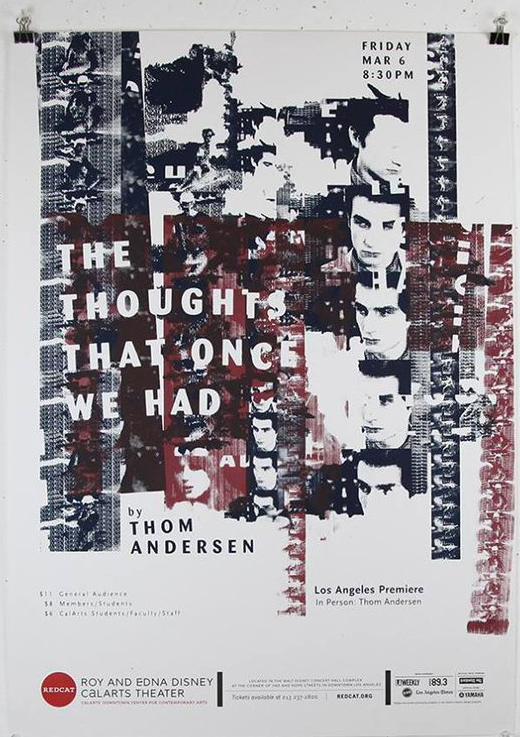
Not a Deleuze Lecture, but What? Thom Andersen’s The Thoughts That Once We Had by Peter Labuza @ Filmaker - 11 Mar, 2015


Not a Deleuze Lecture, but What? Thom Andersen’s The Thoughts That Once We Had

by Peter Labuza 


Read more HERE @ Filmaker website


I’ve heard many mistake the voiceover in Los Angeles Plays Itself as belonging to its writer-director Thom Andersen when it’s actually Encke King. A fair assumption — King speaks in a first person voiceover in a rather curmudgeonly monotone, fitting for the film’s occasionally cantankerous examination of the relationship between the physical spaces of Los Angeles and the way Hollywood films have portrayed them. The real Andersen is a more elusive character. His voice is more casual but less direct, his articulated knowledge of his own projects is tempered, bouncing around a given topic than directly addressing it. He pauses a lot as if he’s itching to get away from the crowds; he’d rather have the movies speak for him.

This might be problematic if you are going to speak at the world premiere of your new film, as Andersen did last Friday when The Thoughts That Once We Had played to a sold-out audience at Los Angeles’ REDCAT Theater. Los Angeles Plays Itself garnered the CalArts professor a cult reputation outside those who had seen his film history documentaries on Edward Muybridge (Zoopraxographer) or the blacklist (Red Hollywood). His newest project, however, is something much more indefinable, as well as exponential in scope: a personal vision of 20th century cinema refracted through the writings of philosopher Gilles Deleuze.

Even for hardcore cinephiles, understanding Deleuze is not an easy task, whose work is often relegated to graduate seminars and academic conferences. Those who have probably picked up Andre Bazin’s What Is Cinema? are much less likely to have paged through Deleuze’s Cinema 1 and Cinema 2. In academic cinema studies circles, Deleuze is an atom bomb — he entered film discourse in the late 1980s at a time when theoretical approaches to understanding cinema (the so-called “Grand Theory” tradition) were being upstaged by the new formalist methods developed by David Bordwell and Kristen Thompson. With his impossibly wordy prose, the French Deleuze also rejected the traditions of psycho-analytical and semiotic approaches to understanding cinema. In its place, however, he created a more elusive theory of cinema as a space where “thought” could be produced. His most famous thesis is his splitting of the history of cinema between the “action-image” (character-motivated action, defined by Classical Hollywood) and the “time-image” (contemplative cinema defined by filmmakers like Ozu and Antonioni). His work then becomes something of a grand synthesis of Bazinian realism, Brechtian discourse, Bergsonian philosophy, all written in a way that has captured passions of many scholars (and frustrated countless others).
At the premiere, Andersen attempted to downplay the influence of Deleuze on the work, commenting, “It’s not a lecture,” but the project evolved out of a yearly seminar he has taught on the film philosopher. The Thoughts That Once We Had (a title coming from the Christina Rossetti poem read in Kiss Me Deadly) isn’t a linear tour through Deleuze; Andersen called the quoted passages a “structuring device” for the director’s own history through the movies. It recalls Godard’s Histoire(s) du cinéma, but without the collage effect of the former work. Boldly, Andersen has forgone voiceover, a crucial element to his past films — the clips and textual quotes from Deleuze must speak for themselves.
The film begins with Deleuze’s “affection-image” and the faces of silent cinema — Griffith, Von Stroheim, Von Sternberg — which he weaves to those in Godard, Cassavetes, and Costa. Andersen then considers World War II through documentary images of the Siege of Leningrad and bombings in Vietnam (using footage from Joris Ivens’s 17th Parallel), before then highlighting the absence of these images in Alain Resnais’s Hiroshima Mon Amour. One of Andersen’s more successful bits is to remove the voice of the characters’ refrains (“You saw nothing in Hiroshima. Nothing”), instead using them as intertitles in communication with the images, the blank spaces acting as placeholders for the absent footage of the bomb.
If one of Los Angeles Plays Itself’s merits was its rigorous argumentative structure, The Thoughts That Once We Had prides itself on being a meandering look through the 20th century through film. There are clever connections — a scene of Jeanne Moreau walking through Paris streets in the 1960s is sewn to the opening of Hou Hsiao-Hsien’s Millennium Mambo, while Chaplin’s protest gag in Modern Times is juxtaposed with the wrongful conviction in Errol Morris’ The Thin Blue Line. These relationships are key to the Deleuze project, where cinema repeats certain gestures again and again, but in Andersen’s conception of them, they felt more like surface play.
More successful was a sequence demonstrating Deleuze’s concept of firstness, secondness, and thirdness through three comedies. Andersen quotes Deleuze’s strange schema: firstness is pure being (Harry Langdon’s turtle-paced comedy, emphasizing his blissful expression), secondness as the forces between objects (Laurel and Hardy’s gag wars, in which each action necessarily leads to the next), and thirdness as something as only existing in relation between firstness and secondness (the many double entendres, physical gags and mistaken identities of the Marx Brothers). Andersen then jumps to the violent murder at the end of Masahiro Shinoda’s Pale Flower (in place of Deleuze’s choice of Hitchcock) to show how the film’s murder works as an expression of all three states. However, my discussion with audience members unfamiliar with Deleuze after the screening indicated they found this sequence particularly hard to follow.
If the film isn’t a history lesson, what is it? It certainly showcases some of Andersen’s favorite films and filmmakers (he claimed his working title was Great Moments from the Cinema): American film noir, various Godard films, a tribute to the “underrated” (according to Andersen) Marlon Brando, and Fritz Lang (the audience particularly ate up Debra Pagent’s erotic dance to a snake from his rather underknown two-part “Indian Epic,” The Tiger of Eschnapur and The Indian Tomb). The film ends with quotes from Deleuze’s hope to restore a “belief in the world” through cinema, using the “As Tears Go By” sequence from Made In U.S.A. But what does Andersen want his audiences to experience? During the Q&A, Andersen appeared anxious about the response, admitting, “I don’t understand the movie myself.” (.... Read full review @ The Filmaker website)